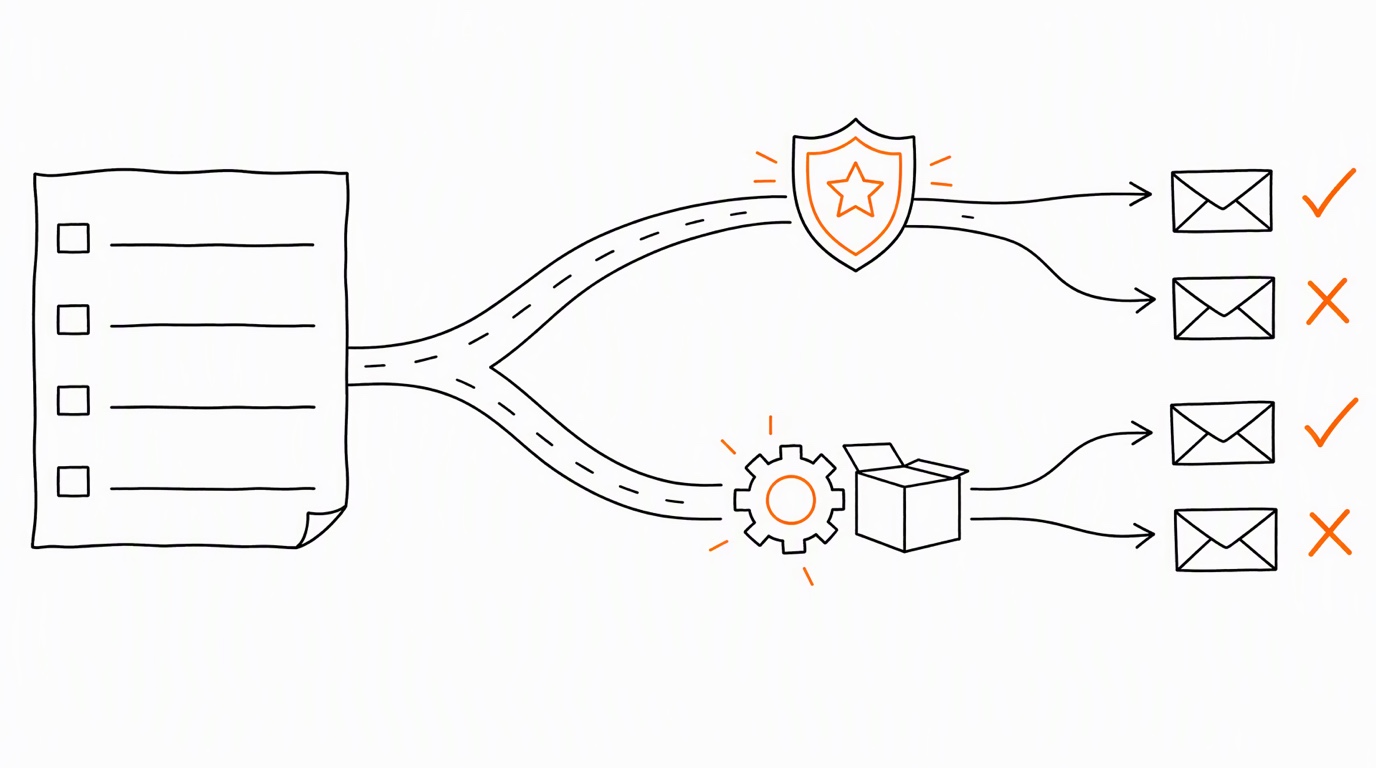
A managed versus self-hosted integration decision assigns responsibility for records, updates, monitoring, support and exit. Write down those duties for each option before comparing prices. Way2's Telegram tracking page provides one example: a managed Pro plan and an Enterprise deployment on the customer's infrastructure, with support terms agreed separately.
Compare four areas: data, operations, support and price. The Telegram plans below illustrate the questions; they do not define the terms of every custom integration. Obtain a scope and quote for your own route before deciding which operating model fits.
What a Managed Versus Self-Hosted Integration Decision Contains
Way2's Telegram page lists Pro at $55 per month for one channel, one bot and one pixel. Enterprise is priced Custom and describes deployment on the customer's server with SLA terms set in the individual agreement. Confirm the current offer and agreed scope before signing.
Pro · managed            $55 / month
"One channel, one bot and one pixel, with real-time statistics for clicks and sent events."
  Landing-to-Telegram binding
  Join and downstream event routing
  Click and sent-event statistics

Enterprise · self-hosted   Custom
"For teams that require deployment on their own infrastructure and a separately agreed support model."
  Deployment on your server
  Your API credentials and data boundary
  SLA terms defined in the individual agreement
A third card on the same block, "Backfill · separate service" priced "By volume", sits outside this comparison: it is a historical import scoped by "Feasibility check before import" and destination attribution-window limits, not a delivery model for the running integration.
The asymmetry in the two quotes above is the finding. "$55 / month" is a subscription price for an enumerated scope: one channel, one bot, one pixel. "Custom" is not a high number hiding behind a word, it is the absence of a published amount, because the scope it prices is written in an agreement rather than on a page. Comparing them requires fixing scope on both sides first, and that is a document exercise, not a spreadsheet one.
For teams that require deployment on their own infrastructure and a separately agreed support model.
The Enterprise offer makes support an agreement-specific responsibility. Ask for the applicable SLA and support boundaries for either operating model before treating response times as a commitment.
Four Axes, One Published Text and One Agreement
The second column gives examples from the Telegram plans. For a custom integration, ask the supplier to answer the same questions in the agreement.
| Axis | Telegram plan example | An answer | Not an answer |
|---|---|---|---|
| Data | "Your API credentials and data boundary"; "operational data and API credentials remain within your environment" | A list of stores holding source and sent-event records, with who may read each and for how long | The adjective "private" with no named store |
| Operations | "Deployment on your server" | Named owner for version updates, retries, monitoring and restore, each with a trigger | "We handle it", no cadence attached |
| Support | "SLA terms defined in the individual agreement" | Clause text, or a written note that no clause exists | A chat reply with response hours |
| Price | "$55 / month" against "Custom" | Both offers quoted for the same scope and the same event volume | Dividing one figure by the other |
Use implementation documentation to identify operational duties, then assign them in the contract. Google's server-side Tag Manager guide describes preview-server setup, server-container URL configuration and periodic server restarts to receive current tagging code. Its preview check verifies the server-container setup; it does not validate a complete conversion path.
These are Google Tag Manager instructions, not terms of a Way2 deployment. Use them as examples when asking who owns maintenance and diagnostics. Hosting choices are discussed in Server-Side GTM Hosting, and a separate gateway workflow in Meta CAPI Gateway Self-Hosted Setup. Both belong to the broader subject of server-side tracking; a CAPI gateway is one implementation pattern.
Where the Operating Model Shows Up in the Event Path
Google Ads provides offline-import summaries at account and conversion-action level, with successful, failed and pending counts. Daily summaries cover the last seven days; job summaries group recent imports by job_id. Multiple requests can share one job ID, so a job count is not necessarily a request count (Monitor offline data diagnostics). These diagnostics describe imports, not the retention policy of your sender. Ask who keeps the source request and response when you need evidence beyond the diagnostic view.
On the Telegram side the transport has an owner too. Bot API documents update delivery as an HTTPS POST to a URL you set, with the provider retrying an unsuccessful request "and give up after a reasonable amount of attempts" - no attempt count is published, so nobody should quote one (Telegram Bot API). Webhook state is observable through fields such as pending_update_count ("Number of updates awaiting delivery"), last_error_date and last_error_message, and the connection ceiling is described in the provider's own words as a knob for "the load on your bot's server". Whoever holds the endpoint therefore also holds the duty to watch it. Which record survives an outage, and what a self-hosted pipeline can and cannot see, is the subject of Self-Hosted Telegram Tracking: What Your Pipeline Can See and What It Cannot; the measurement consequences of running retries and queues are laid out in Self-Hosted Telegram Tracking vs Managed: Choosing by Evidence. Retry mechanics themselves are Server-Side Retries and Idempotency.
Before signing either option, run this sequence and stop at the first question you cannot answer with an artifact rather than a promise.
- Name the stores. Write down where the source event record and the sent-event record live in each option, who can read them, and for how long.
- Assign the four operational duties. Updates, retries, monitoring, restore: one owner each, per option, in the same table.
- Read the support text. Copy the clause or record the absence. A managed versus self-hosted integration comparison is incomplete without this line.
- Fix scope before price. Ask for the Enterprise number against the same channel, bot and pixel count the subscription card enumerates, or state that the two are not comparable.
- Ask for the retention period in writing and a sanitized aged record as a sample. If no suitable sample is available, define an acceptance check with a date and owner instead of treating retention as verified.
- Write the exit condition. Ask which export answers "what did we accumulate" and confirm the answer is a file rather than a screenshot.
clause inventory (one row per axis, filled from documents only)
data       = <store list> / <reader roles> / <retention>
operations = <update owner> / <retry owner> / <monitor owner> / <restore owner>
support    = <clause text or "absent">
price      = <scope fixed> -> <figure> ; otherwise "not comparable"
Question, Evidence, Next Test
| Question in writing | Evidence that answers it | Next test |
|---|---|---|
| Where do our records physically sit? | Store inventory naming tables or services plus reader roles | Ask for one record by id and time, in both options; before a pilot runs the substitute is a synthetic record from the contractor's test stand, not a production log |
| Who applies version updates? | The clause or runbook line assigning the duty | Check the cadence, not the owner's job title |
| Is there an SLA on the managed card? | Contract text, or the page where nothing is stated | Treat any quoted hours as unproven until the clause appears |
| What happens to data after termination? | Export description with format and destination | Request a sample export of one conversion path, taken from a test stand while no live path exists |
| Which side monitors delivery failures? | Named dashboard or log plus the alert route | Open the panel for a past date and compare with your own log |
| Can the same event be observed on both sides? | Two records: source event and sent event | Reconcile one path instead of two totals |
| What does the price cover? | Scope statement listing channels, bots, pixels and volume band | Re-quote with identical scope, then compare |
| Does a deployment change attribution? | Nothing published, on either side | Stop there; the destination's own wording settles it |
The last row deserves the product's own boundary sentence rather than a paraphrase, since it is the one place where a hosting decision is routinely overclaimed.
These records describe the integration path. They do not promise attribution or bidding outcomes inside an ad platform.
What This Comparison Does Not Decide
Three questions are outside this guide by design. Which system is responsible for each segment between a source event and an ad platform record is an architecture question with its own map of owners and failure points; here the segments appear only as evidence carriers. Where request signing material, tokens and keys physically live is a credential-boundary question, and the tariff line "Your API credentials and data boundary" states only that the boundary is part of the Enterprise offer, nothing about key custody, rotation or scope. How complete your event coverage is, expressed as percentages against clicks or joins, is a measurement question: this article assigns duties and asks for artifacts, it does not compute ratios, and none of the published plan text contains a denominator to compute them from.
Compare total costs only after both offers specify the same workload, responsibilities and support scope. The published Pro price does not supply the missing Enterprise quote or the cost of your own operations. Confirm those inputs in the agreement.
Need to compare operating models?
Share the proposed scope and the contract question you need to resolve. The first consultation is free.
Do not send tokens or passwords.
Sources
Sources
Way2 services